The 2026 Tesla Model 2: Will the $25,000 "Redwood" Finally Disrupt the Budget Market?
Jan 21, 2026
Hi, we're MyWagons. We provide owner reviews of cars for extended reliability data and personal opinions of the real owners. Take a look by searching a car, or continue reading the article.
The quest for an affordable, mass-market electric vehicle has been the "North Star" of Tesla’s Master Plan since Elon Musk first put pen to paper in 2006. For years, the $25,000 Tesla—frequently referred to by the public as the "Model 2" or "Model Q"—seemed like a distant mirage, constantly delayed by the production hell of the Model 3 and the complex engineering of the Cybertruck. However, as we move into 2026, the mirage is finally taking a physical form. Codenamed Project Redwood, this vehicle represents the most significant pivot in Tesla's history.
Tesla is no longer just competing for the luxury or "premium-mid" buyer. With the Model 2, they are aiming directly at the heart of the global automotive market: the budget-conscious consumer who currently drives a Toyota Corolla, a Honda Civic, or a Volkswagen Golf. But in a 2026 landscape where Chinese manufacturers like BYD are already selling sub-$20,000 EVs globally, the question isn't just whether Tesla can build a $25,000 car—it’s whether they can build one that is good enough to dominate.
The "Unboxed" Revolution: How Tesla Plans to Halve Costs
To reach the $25,000 price point without sacrificing the profit margins that Wall Street demands, Tesla has had to throw out the automotive manufacturing playbook. The 2026 Model 2 is the debut vehicle for the "Unboxed" Process, also known internally as the GAME (Global Automotive Modular Evolution) platform.
Traditional car manufacturing involves a "conveyor belt" where a car shell moves through various stations, having parts bolted on from the outside in. This is inefficient because it requires workers to crawl inside the vehicle and limits how many people can work on a single car at once. Tesla’s Unboxed Process flips this: the car is built in six distinct modules (front, rear, floor, etc.) simultaneously. The seats are mounted directly to the battery pack, the interior trim is installed while the sides are still open, and the entire vehicle is snapped together like Legos in the final stage.
By using this modular approach, Tesla aims to:
Reduce factory footprint by 40%, allowing for smaller, cheaper Gigafactories.
Slash production costs by up to 50% compared to the Model 3.
Speed up assembly by 25%, targeting a production rate of over 10,000 vehicles per week per factory.
Design and Specifications: Project Redwood
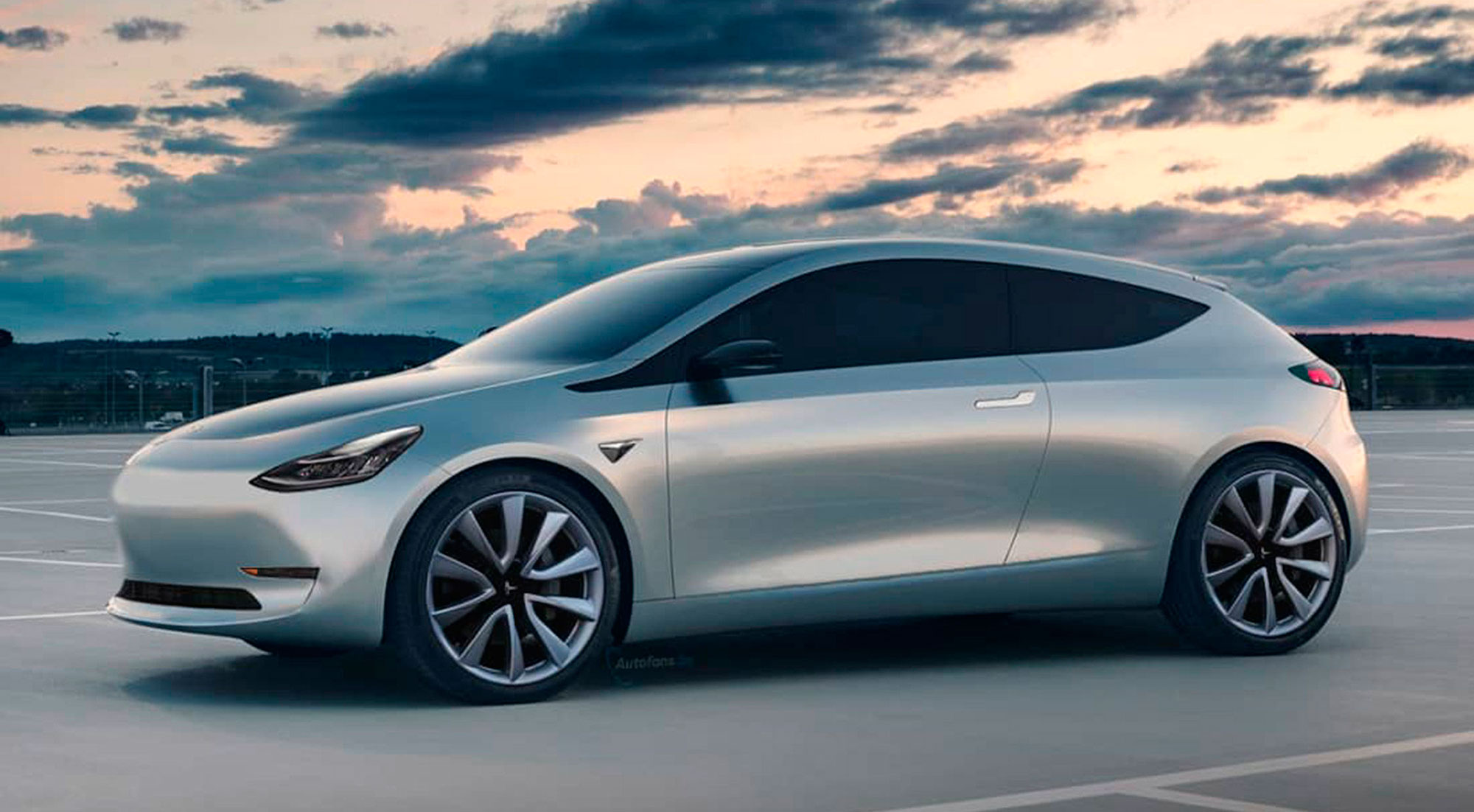
While Tesla has kept the final design of the Model 2 under tight wraps, 2026 insiders and "Redwood" prototypes spotted near Giga Texas suggest a compact crossover/hatchback silhouette. Think of a "shrunken Model Y" with a more aggressive, aerodynamic taper. The car is expected to be roughly 15% shorter than the Model 3, making it ideal for the cramped streets of European and Chinese cities where Tesla needs to reclaim market share.
Expected 2026 Tesla Model 2 Specifications:
Starting Price: $24,990 (before federal and state incentives).
Range: 250 to 300 miles (400–480 km) on a single charge.
Battery: LFP (Lithium Iron Phosphate) chemistry, which is cheaper, more durable, and doesn't require nickel or cobalt.
NACS Charging: Standard native Tesla Supercharger port, capable of 150 kW peak charging.
Acceleration: 0-60 mph in roughly 5.8 to 6.5 seconds.
To save weight and cost, the Model 2 will likely feature a more minimalist interior than even the Model 3. Expect a single central screen, the removal of traditional door handles in favor of "press-to-open" buttons, and the extensive use of high-quality recycled textiles instead of vegan leather.
The Battery Secret: Why LFP is the Key
The only way to hit a $25,000 target in 2026 is to solve the battery cost problem. The Model 2 will rely heavily on LFP batteries, sourced primarily from partners like CATL and BYD, as well as Tesla's own domestic production lines. Unlike the NCA/NCM batteries found in the high-performance Model S or Model X, LFP batteries can be charged to 100% daily without significant degradation and are much less prone to thermal runaway.
For the budget buyer, this is actually a benefit. They get a car that can be treated like a smartphone—plugged in every night and topped up without worry. By utilizing a "structural" battery pack where the cells themselves provide the strength for the car's floor, Tesla is able to remove the heavy steel or aluminum frame that usually holds the battery, further increasing efficiency and lowering the car's center of gravity for that signature Tesla handling.
Facing the Chinese EV Wave
Tesla’s biggest challenge in 2026 isn't coming from Detroit or Wolfsburg; it's coming from Shenzhen. The BYD Dolphin and MG4 Electric have already established themselves as the "people’s EVs" in Europe and Southeast Asia. These cars are often priced between $22,000 and $28,000 and offer competitive range and tech.
Tesla's edge remains its Software and Infrastructure. While a BYD might be cheaper, it doesn't have the integrated Tesla Supercharger network, nor does it have the Silicon Valley-grade software that allows for seamless route planning and entertainment. Tesla is also banking on FSD (Full Self-Driving) v13. By offering a "Robotaxi-ready" version of the Model 2, Tesla hopes to convince buyers that their $25,000 car is actually an investment that could one day earn money for them as a driverless ride-share vehicle.
The Verdict: Is 2026 the Year Tesla Wins the Mass Market?
The 2026 Tesla Model 2 is the car the industry has been waiting for—and the car legacy automakers have been fearing. If Tesla can successfully execute the Unboxed Process and deliver a 250-mile EV for $25,000, they will effectively render many entry-level gasoline cars obsolete overnight.
However, the "Elon Time" factor remains. With production initially slated for late 2025 but mass-market ramp-up occurring throughout 2026, the window is narrow. If Tesla can avoid the quality control issues that plagued the early Model 3 and keep the price strictly at that $25,000 promise, "Redwood" won't just be a new car—it will be the final nail in the coffin for the internal combustion engine's dominance in the budget segment. For the first time, "going electric" won't be a luxury choice; it will be the only logical financial choice.