Ford’s Wildest Experiment: Everything We Know About the 2026 Mustang Raptor
Jan 17, 2026
Hi, we're MyWagons. We provide owner reviews of cars for extended reliability data and personal opinions of the real owners. Take a look by searching a car, or continue reading the article.
For decades, the Ford Mustang has been the undisputed symbol of the American asphalt. It is a car built for the drag strip, the coastal highway, and the winding mountain pass. But as we move into 2026, Ford is preparing to do something that purists might consider sacrilege, yet enthusiasts are calling the ultimate "what if" scenario. The Mustang is leaving the pavement.
The 2026 Ford Mustang Raptor is no longer just a rumor whispered in the halls of Dearborn; it is a full-blown engineering project aimed at creating a new category: the off-road muscle coupe. Following in the footsteps of the ultra-successful F-150 Raptor, Bronco Raptor, and Ranger Raptor, this "pony with mudflaps" is Ford’s response to a growing trend of "safari-style" performance cars like the Porsche 911 Dakar and the Lamborghini Huracán Sterrato.
The Engineering Feat: A Muscle Car with a 4x4 Heart
The transition from a low-slung street fighter to a high-clearance desert runner requires more than just a lift kit. Ford’s engineers have reportedly overhauled the S650 platform to accommodate a level of structural abuse usually reserved for trophy trucks. The most significant mechanical change for the 2026 Mustang Raptor is the move to an Advanced All-Wheel Drive (AWD) system.
Historically, the Mustang has been a rear-wheel-drive icon. However, to handle the unpredictable surfaces of the desert, Ford has integrated a sophisticated AWD setup that can shift power between axles in milliseconds. This isn't a traditional 4x4 system with a heavy transfer case; it is a performance-oriented AWD designed for high-speed traction on sand, gravel, and mud. This marks the first time a gas-powered Mustang coupe will officially send power to all four wheels from the factory.
Supporting this drivetrain is the crown jewel of the Raptor family: the Fox Live Valve 3.1 Internal Bypass shocks. These dampers allow the car to adjust its compression and rebound in real-time based on sensor data. Whether you are hitting a jump in the dunes or cruising over potholes on the highway, the suspension "reads" the road and stiffens or softens instantly. To make room for the massive 37-inch BFGoodrich All-Terrain tires, Ford has widened the track and added aggressive flared wheel arches, giving the car a stance that is as intimidating as it is functional.
Powertrain Options: Coyote V8 and the Supercharged "R"
Ford knows that a Raptor is nothing without a heart that roars. For the 2026 model year, two distinct levels of performance are expected. The standard Mustang Raptor will likely utilize a specifically tuned version of the 5.0-liter Coyote V8, producing roughly 500 horsepower. This engine is favored for its reliability and high-revving nature, which is perfect for maintaining momentum in deep sand.
However, for those who believe too much power is never enough, the Mustang Raptor R is the headline act. Rumors suggest this variant will inherit the 5.2-liter supercharged "Predator" V8 from the F-150 Raptor R and the upcoming Mustang GTD. In this configuration, the Raptor R could produce north of 720 to 800 horsepower.
To manage this immense power in off-road scenarios, Ford is sticking with a 10-speed SelectShift automatic transmission. While purists may mourn the lack of a manual gearbox, the 10-speed is a necessity for the Raptor's complex G.O.A.T. (Goes Over Any Terrain) drive modes. These modes—including Baja, Rock Crawl, and Mud/Ruts—recalibrate the throttle response, transmission shift points, and AWD distribution to ensure the car stays composed no matter how hostile the environment becomes.
Aggressive Design: Function Over Form
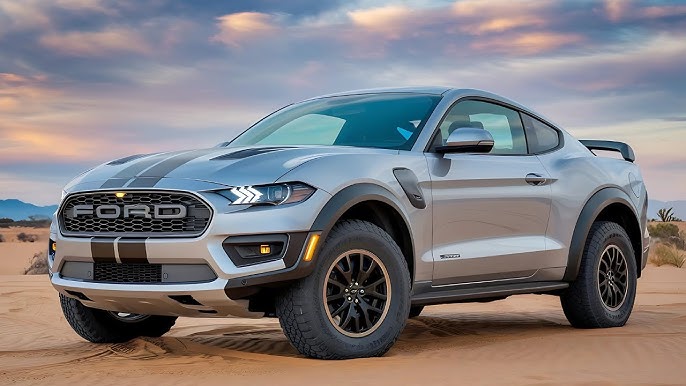
Visually, the 2026 Mustang Raptor looks like it escaped from a "Mad Max" film set. Every design element serves a purpose. The traditional Mustang grille has been replaced with the signature "FORD" block-letter grille seen on its truck siblings, optimized for maximum airflow to cool the hard-working V8.
The hood features functional heat extractors and a massive scoop to feed the intake, while the underbody is shielded by heavy-duty steel skid plates. These plates protect the vital components—the oil pan, transmission, and fuel tank—from the "death by a thousand rocks" that occurs during high-speed desert runs.
One of the most talked-about features is the 2-inch factory lift, which provides enough ground clearance to clear obstacles that would tear the bumper off a standard Mustang GT. When combined with the wider bodywork and integrated LED off-road lighting, the Mustang Raptor creates a new silhouette on the horizon: a sleek coupe profile perched atop a rugged, industrial-grade chassis.
The Interior: Rugged Luxury and Tech
Steering inside the 2026 Mustang Raptor reveals a cabin that balances high-performance racing with off-road utility. While it retains the massive 13.2-inch SYNC 4 touchscreen and 12.4-inch digital instrument cluster from the standard Mustang, the Raptor adds specific data pages for off-roaders. Drivers can monitor their pitch, roll, steering angle, and tire pressure in high-definition graphics.
The seats are a highlight. Ford has fitted the Raptor with Recaro performance seats that feature heavy side bolsters to keep passengers pinned during high-G maneuvers. However, unlike the suede-heavy interiors of the Dark Horse, the Raptor utilizes more durable, easy-to-clean materials. Rubberized floor mats and weather-resistant surfaces ensure that after a day in the mud, you can wipe the interior down without ruining the "luxury" feel.
A new Terrain Management System dial sits on the center console, allowing the driver to toggle through the drive modes on the fly. There is also a dedicated "R" button on the steering wheel, which functions as a "hotkey" to instantly engage the driver’s favorite custom performance settings for suspension, exhaust, and steering weight.
Market Positioning and The $90,000 Price Tag
The 2026 Ford Mustang Raptor is not intended to be a volume seller. It is a halo car designed to capture the imagination of a new generation of buyers. With an estimated starting price of $90,000, and the Raptor R likely pushing past $110,000, it sits in a premium bracket that rivals high-end sports cars and luxury SUVs alike.
Ford is targeting a very specific demographic: the enthusiast who wants a car that can "do it all." In the morning, you can take the Mustang Raptor to a local Cars & Coffee; in the afternoon, you can drive it across a dry lake bed at 100 mph. It is the ultimate expression of automotive freedom. By pricing it below the $200,000+ price tags of the Porsche 911 Dakar and the Lamborghini Huracán Sterrato, Ford is effectively "democratizing" the off-road supercar segment, making this level of specialized performance accessible to a wider (though still wealthy) audience.
The Verdict on Ford's Boldest Pony
The 2026 Mustang Raptor represents a massive shift in Ford’s strategy. It is proof that the company is no longer afraid to experiment with its most sacred brand. While some may argue that a Mustang should never have AWD or a lift kit, the reality of the 2026 market is that versatility is king.
By merging the legendary power of the Coyote V8 with the desert-conquering hardware of the Raptor family, Ford has created something truly unique. It is a vehicle that respects the heritage of the pony car while embracing the rugged, adventurous spirit that has made the Raptor nameplate a global phenomenon. Whether you’re a purist or a rebel, there’s no denying that the 2026 Mustang Raptor is the wildest experiment to ever come out of Maranello—or in this case, Michigan.