Honda Prelude 2.0: Why the 2026 Production Model is the Hybrid Coupe We’ve Been Waiting For
Jan 18, 2026
Hi, we're MyWagons. We provide owner reviews of cars for extended reliability data and personal opinions of the real owners. Take a look by searching a car, or continue reading the article.
After more than twenty years in the shadows, the Honda Prelude is officially back. But for those expecting a high-revving, manual-gearbox ghost of the 1990s, the 2026 Honda Prelude is doing things differently. It isn't just a nostalgic revival; it is a calculated repositioning of the sporty coupe for an era defined by efficiency and daily usability. By blending a fuel-sipping hybrid heart with the aggressive bones of the Civic Type R, Honda has created a "Hybrid 2.0" that finally prioritizes driver engagement alongside mpg.
The Powertrain: Efficiency Meets Performance
Under the sleek, "double-bubble" roofline sits a version of the 2.0-liter fourth-generation hybrid system found in the latest Civic and Accord. It pairs an Atkinson-cycle four-cylinder engine with two powerful electric motors to produce a combined 200 horsepower and 232 lb-ft of torque.
While 200 horsepower might sound modest in a world of 1,000-hp electric SUVs, the Prelude’s secret weapon is its torque. Because the electric motors provide instant shove from zero RPM, the Prelude feels significantly "zippier" in city traffic than its raw numbers suggest. Early estimates put the 0–60 mph sprint at approximately 6.0 seconds, placing it right in the thick of the fight with the Mazda MX-5 Miata and the Toyota GR86. More importantly, it achieves this while delivering an estimated 44 to 48 MPG combined, proving that you don't have to choose between a fun commute and a low fuel bill.
The Civic Type R Connection: Handling Above All
Honda knew that a hybrid coupe would be dead on arrival if it felt like a heavy econobox. To ensure the Prelude earned its nameplate, engineers raided the Civic Type R parts bin. The 2026 Prelude features:
Dual-Axis Strut Front Suspension: A specialized setup taken directly from the Type R to virtually eliminate torque steer—a common plague for high-torque front-wheel-drive cars.
Brembo Braking System: Large, four-piston aluminum front calipers (finished in a signature "Prelude Blue") provide the stopping power necessary for spirited backroad driving.
Adaptive Dampers: Standard on the production model, these dampers allow the car to switch from a comfortable "GT" cruiser to a stiff, corner-carving machine at the touch of a button.
By using these high-performance components, Honda has given the Prelude a level of mechanical grip and steering precision that far exceeds its Civic Hybrid sibling. It’s a car designed for the "joy of driving," even if it doesn't have a traditional gearbox.
S+ Shift: The "Fake" Gearbox That Actually Works
The biggest point of contention for purists is the lack of a manual transmission. In its place, Honda has introduced a new system called S+ Shift. While the car uses an eCVT (electronic continuously variable transmission), the S+ Shift mode uses the electric motors and engine mapping to simulate the sensation of a 7-speed dual-clutch transmission.
When activated via a button on the center console, the car "shifts" with distinct interrupts in power, provides rev-matched downshifts when you click the metal steering-wheel paddles, and even mimics the "blip" of a throttle. In an age where even the Hyundai Ioniq 5 N has proven that simulated gears can add genuine fun to an electrified drive, Honda’s S+ Shift is designed to bridge the emotional gap for those who miss rowing their own gears.
A Cabin Built for the Modern Grand Tourer
Inside, the 2026 Prelude is a sophisticated evolution of the current Honda design language. It moves away from the "racetrack-ready" austerity of the Type R and toward a premium Grand Touring (GT) feel.
Tech-Forward Dash: A 10.2-inch digital instrument cluster is paired with a 9-inch HD touchscreen featuring Google Built-In. This means native Google Maps, Google Assistant, and Play Store integration are standard.
Seating and Practicality: The 2+2 seating configuration features leather-trimmed sport seats with blue stitching to match the exterior accents. Despite its low profile, the liftback design offers surprising utility, with enough cargo space for two sets of golf bags when the rear seats are folded.
Premium Sound: Every model comes standard with an 8-speaker Bose Premium Audio system, ensuring the soundtrack inside the cabin is as high-quality as the engineering under the hood.
Design: The Glider-Inspired Aesthetic
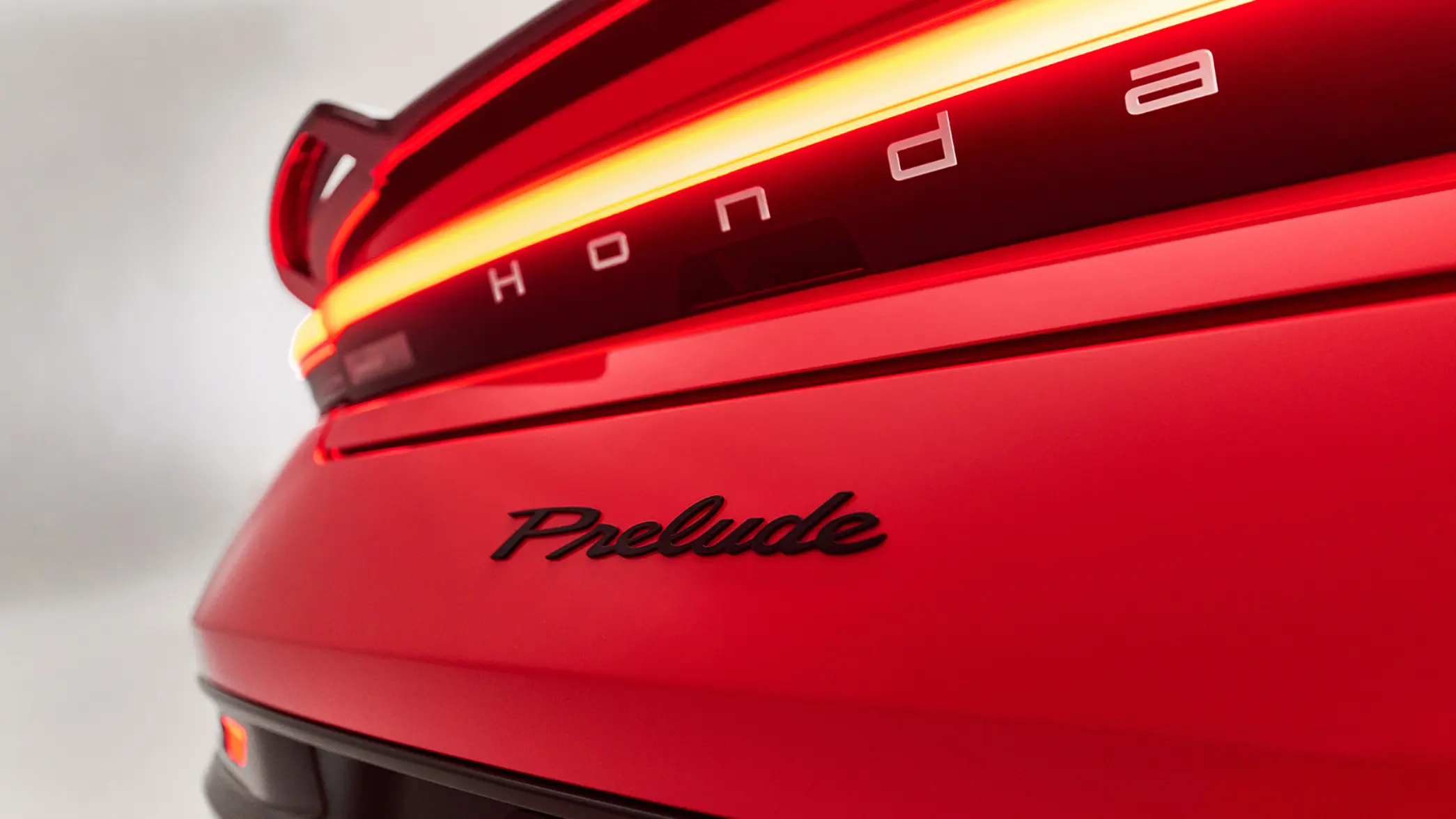
The 2026 production model stays remarkably true to the concept car that stunned audiences at the Tokyo Mobility Show. Inspired by the clean lines of a glider, the Prelude features a low, sharp nose, flush door handles, and a full-width LED taillight bar.
The proportions are classic coupe: a long hood, a swept-back greenhouse, and flared fenders that house 19-inch machine-finished black wheels. It avoids the overly aggressive vents and wings of the Civic Type R, opting instead for "sophisticated muscle" that looks at home at a valet stand or a track day.
The Verdict: Who is the 2026 Prelude For?
The new Prelude isn't trying to beat the Toyota GR86 in a drift competition, nor is it trying to out-accelerate a Tesla. It is carving out a new niche: the Efficient Enthusiast.
Priced around $42,000, it is a premium alternative for the buyer who wants a stylish, head-turning coupe that handles like a dream but doesn't require the compromises of a high-maintenance sports car or the "range anxiety" of a full EV. It is a mature, refined, and incredibly efficient take on the sports coupe—making it exactly the hybrid we’ve been waiting for in 2026.
Would you like me to create a comparison chart showing how the 2026 Prelude stacks up against the Toyota GR86 and the Acura Integra in terms of monthly fuel costs and performance?