Ferrari’s First EV: What to Expect from the $500,000 Electric SUV Launching in 2026
Jan 14, 2026
Hi, we're MyWagons. We provide owner reviews of cars for extended reliability data and personal opinions of the real owners. Take a look by searching a car, or continue reading the article.
Explore everything we know about Ferrari's first all-electric vehicle (SUV). From its $500,000 price tag and 1,000 HP quad-motor setup to its revolutionary "electric guitar" sound identity, discover how the 2026 Ferrari Elettrica is redefining the luxury EV landscape.
The Electric Shock from Maranello
For decades, the soul of a Ferrari has been defined by the mechanical symphony of a high-revving internal combustion engine. Whether it was the piercing shriek of a V12 or the guttural roar of a twin-turbo V8, the "voice" of the Prancing Horse was its calling card. But as we move through 2026, the automotive world is witnessing a historic pivot.
Ferrari is officially entering the electric era.
Codenamed "Elettrica," Ferrari's first fully electric vehicle is not just a change in powertrain; it is a total reimagining of what a luxury performance vehicle can be. Positioning itself as a high-riding, four-door, four-seater—effectively an electric counterpart to the world-beating Purosangue—this SUV-styled GT is aimed at the absolute pinnacle of the market. With a rumored starting price of $500,000, Ferrari isn't just joining the EV race; it’s attempting to own the podium.
The Price of Exclusivity: Why $500,000?
When news first broke that Ferrari’s inaugural EV would carry a price tag north of half a million dollars, the industry gasped. To put that in perspective, the average sale price of a Ferrari in early 2025 was approximately $380,000.
The $500,000 figure (roughly €500,000) reflects several key strategic moves by Maranello:
Preserving Margins: Developing an entirely new electric architecture from scratch is a multi-billion dollar endeavor. Ferrari is ensuring that its industry-leading profit margins remain intact even during this capital-intensive transition.
The "E-Building" Investment: Ferrari recently opened its dedicated "e-building" in Maranello—a state-of-the-art facility designed to handle the production of EVs, hybrids, and internal combustion engines side-by-side. The price tag helps recoup the investment in this hyper-advanced manufacturing hub.
Positioning Above the Competition: While mass-market EV prices are falling, Ferrari is intentionally moving in the opposite direction. By pricing the Elettrica significantly higher than the Lamborghini Lanzador or the upcoming Bentley EV, Ferrari maintains the scarcity and prestige that defines the brand.
Quad-Motor Performance: A New Benchmark for 1,000 HP
Ferrari has never been about "spec sheet racing" alone, but the numbers for the 2026 EV are nonetheless staggering. Unlike many competitors who utilize dual or triple-motor setups, Ferrari has opted for a Quad-Motor Powertrain—one independent motor for each wheel.
Key Performance Specifications:
Total Power Output: Exceeding 1,000 Horsepower (736+ kW) in "Boost Mode."
0–100 km/h (0–62 mph): A targeted 2.5 seconds.
Top Speed: 310 km/h (193 mph).
Torque Vectoring: With four independent motors, the car offers unprecedented control over each wheel, allowing for "impossible" cornering speeds and mid-corner adjustments that no mechanical differential could match.
The front e-axle features two motors that spin up to 30,000 RPM, while the rear dual-motor assembly can hit 25,500 RPM. This high rotational speed allows Ferrari to use smaller, lighter motors while still delivering massive torque—reportedly up to 8,000 Nm at the wheels.
The "Sound" of Soul: The Electric Guitar Approach
Perhaps the biggest hurdle for Ferrari was the loss of engine noise. CEO Benedetto Vigna has been adamant that "emotion" is a key pillar of the brand. To solve the silence of electric motors, Ferrari engineers have rejected the idea of "fake" synthesized engine sounds pumped through speakers.
Instead, they have developed a patented acoustic system that works like an electric guitar pick-up. High-precision sensors (accelerometers) are mounted directly to the motor and inverter casings to capture the raw, mechanical vibrations of the high-revving powertrain. These vibrations are then amplified and projected through the car’s chassis and dedicated sound resonators.
The result? An authentic, "living" soundtrack that changes in pitch and intensity based on throttle position and motor load. It isn't a V12, but it is a real mechanical voice that provides the driver with the vital sensory feedback missing from most "silent" EVs.
Driving Dynamics: Active Suspension and "Torque Shift"
Ferrari’s goal for 2026 is to prove that an EV can handle with the same agility as a mid-engine supercar. Despite an estimated curb weight of 2,300 kg (5,070 lbs)—the heaviest Ferrari to date—the Elettrica utilizes cutting-edge chassis tech to mask its mass.
48V Active Suspension
Borrowed and refined from the Purosangue and the F80 hypercar, the Elettrica features a 48V active suspension system. This system uses powerful electric actuators at each corner to counteract body roll instantly. It allows the car to remain perfectly flat during high-speed cornering while still offering a "GT-like" supple ride over rough city streets.
Torque Shift Engagement
To satisfy traditionalists, Ferrari has introduced a "Torque Shift" system. Using the familiar steering-wheel-mounted paddles, drivers can simulate the sensation of gear changes. The software momentarily interrupts torque delivery to mimic the "kick" of a dual-clutch transmission, providing a familiar sense of rhythm and engagement that most "one-speed" EVs lack.
Battery Architecture and Range: Is It Practical?
The 2026 Ferrari EV is built on a bespoke 880-Volt Architecture, designed for ultra-fast thermal management and charging speeds.
Battery Capacity: 122 kWh (Gross).
Energy Density: 195 Wh/kg—reportedly the highest energy density of any production EV battery in 2026.
Range: A targeted 530 km (330 miles) on the WLTP cycle.
Charging: Support for 350 kW DC Fast Charging, allowing a 10% to 80% top-up in approximately 25 minutes.
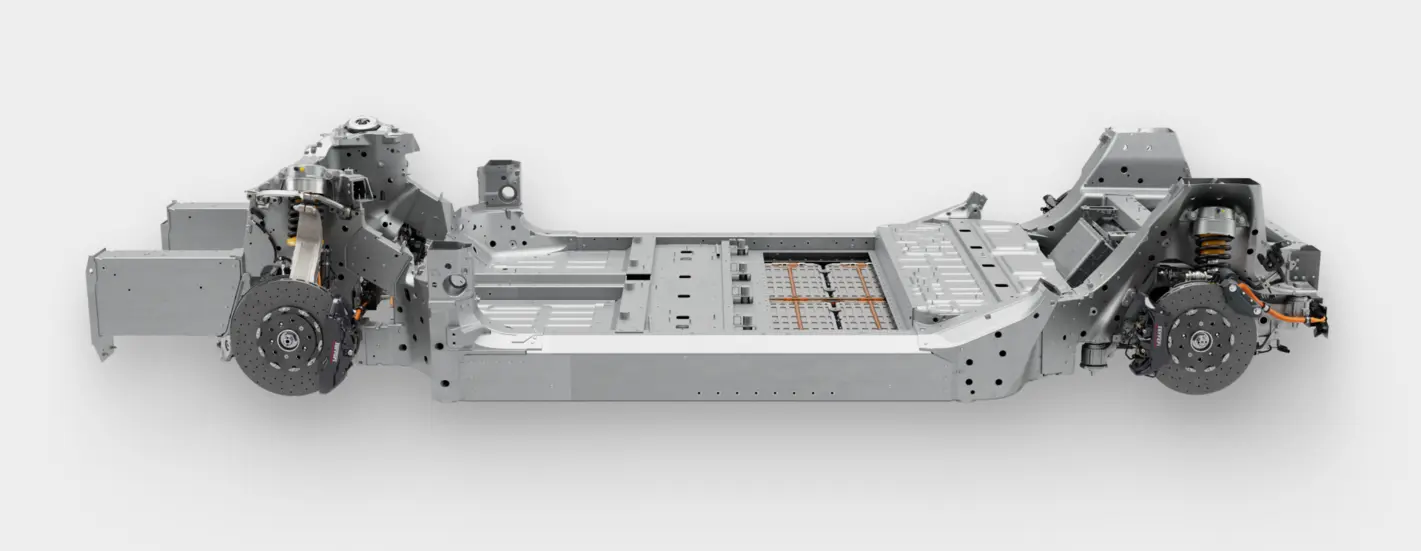
The battery pack is fully integrated into the chassis floor, acting as a structural member. This integration lowers the car’s center of gravity by a massive 80mm compared to its internal combustion siblings, significantly improving high-speed stability.

Design and Sustainability: Recycled Luxury
While the final exterior reveal is scheduled for the Spring of 2026, spy shots and leaks suggest a "front-forward" cabin design. Because there is no massive engine up front, the driver sits closer to the front axle, creating an aggressive, cab-forward silhouette with a long wheelbase and extremely short overhangs.
In a first for the brand, the chassis and bodyshell utilize 75% recycled aluminum. This move isn't just about PR; it significantly reduces the carbon footprint of production (estimated saving of 6.7 tons of CO2 per car) while maintaining the structural rigidity required for a 1,000 HP machine.
The Competition: Ferrari vs. the World
Ferrari is entering a segment that is suddenly becoming very crowded. By late 2026, the Elettrica will be facing off against:
Lamborghini Lanzador: A "high-ground-clearance GT" that targets a younger, tech-focused audience.
Bentley’s Urban SUV: The ultimate expression of electric British luxury.
Lucid Sapphire / Tesla Model S Plaid: While significantly cheaper, these sedans offer comparable (or superior) raw acceleration, forcing Ferrari to rely on its "brand magic" and superior chassis dynamics to justify the $500k price.
Can a Ferrari be Electric?
The 2026 Ferrari Elettrica is a gamble of historic proportions. If Ferrari succeeds, it will prove that the "Prancing Horse" identity is not tied to a specific fuel source, but to a philosophy of engineering, sound, and theater.
At $500,000, this electric SUV isn't trying to be a car for everyone. It is a highly exclusive, tech-heavy statement designed for the owner who wants the future of performance without sacrificing the prestige of Maranello. As the world premiere approaches in Spring 2026, all eyes are on the e-building to see if Ferrari can truly deliver an electric soul.